Written in 2026 to document what we prepared before our 2022 trip. The advice is evergreen.
=== ARTICLE START ===
Some of the twelve people we took to Paris in 2022 had never ridden a subway in their lives. Some had grown up in big cities that simply do not have one. That sounds like a small thing until you are standing on a platform with a crowd behind you, trying to work out which way the train is going. It is not hard once you know the pattern, but finding the pattern takes a few minutes, and a busy platform is not where you want to spend them.
So the lessons started at home, in the newsletters, and continued a little at a time all week. On arrival day, when everyone was tired, we simply rode together with nobody in a hurry. By the end of the week, the people who had been most nervous were taking trains across the city on their own. This is what we taught them, and what we would want anyone heading to Paris to know.
Paris Is Organized in Circles
Paris is divided into twenty numbered districts called arrondissements. They spiral outward from the center like a snail shell, starting with the 1st around the Louvre and winding clockwise from there. Each one has its own character, its own neighborhoods, or quartiers, and its own feel. You will see them referred to by number and often abbreviated: 1er for the first, 2e for the second, and so on.
Why does this matter? Because the single best thing you can do for your daily plan is group your activities by arrondissement. A day built around the 7th, with the Eiffel Tower, the Musée d’Orsay and the Rodin Museum, is a completely different day from one built around Le Marais in the 3rd and 4th. Grouping by neighborhood means less time underground and more time in the places you came to see. It also means that when a group splits up for an afternoon, everyone is close enough to find each other again for dinner.
The Metro Is Your Best Friend Once You Understand It
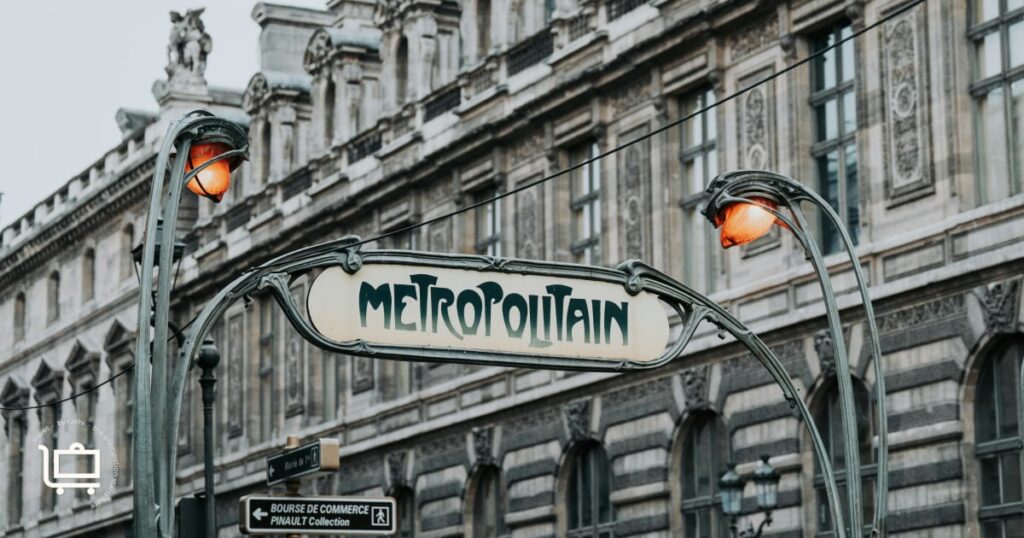
When we traveled, the Paris Metro had sixteen lines: 1 through 14, plus 3bis and 7bis. Think of the bis lines as half-steps, added later without renumbering everything else. Every line has its own color on the map, and maps are posted throughout every station. It is worth downloading one before you leave, or printing one from the RATP website.
Here is the whole system, and it works on almost any subway in the world.
- Find where you are on the map, and where you want to go.
- Find the line that connects them, with a transfer if you need one.
- Follow that line past your stop, all the way to the end. The name of that last station is your direction.
That end-of-the-line name is what the signs in the station and on the platform show, so it tells you which platform to stand on. Your stop will always sit somewhere between where you are standing and that last station.
For example, in 2022 we had the group get on at Pyrénées to go to Télégraphe. That is line 11, the brown one. Télégraphe sits between Pyrénées and the eastern end of the line, which back then was Mairie des Lilas, so you followed the signs for Mairie des Lilas. Line 11 has since been extended, so the same trip today means following the signs for Rosny–Bois-Perrier. That is exactly why you learn the method rather than memorizing the sign. Once it clicks, it clicks for good.
It is not just Paris, either. Washington, D.C. signs its trains the same way, by the last station on the line. London’s Tube and New York’s subway word it differently, eastbound and westbound in London, uptown and downtown in New York, but the end-of-the-line station still shows on the train and the platform screens, and the same thinking gets you where you are going. When my brother-in-law Tim and his wife, Rachel, came back from an EF tour of Greece, they told us how glad they were that we had taught them to use the trains. They were comfortable enough that in their free time they took some of the other people from their tour along with them.
The tunnels are long, the stairs are frequent, and escalators are not guaranteed. Most of these stations were built a very long time ago. If anyone in your group has trouble with stairs, check the accessibility of specific stations before you rely on them.
Rush hour is real. Cars at peak times are crowded in a way that makes twelve people boarding together feel optimistic. Board when you can, keep your bag in front of you, and do not panic if your group ends up in separate cars. As I told our group before we left: everyone knows where we are going, and we will connect eventually. None of it is difficult. Most of it is new, and new combined with unknown can feel scary.
The Paris Visite Pass
For a week that covers most of the city, the Paris Visite pass gives you unlimited travel on the Metro, buses and RER regional trains for a set number of consecutive days. We have used it on more than one trip, and it pays for itself quickly when you are moving between neighborhoods several times a day. For this trip we bought the passes ahead of time and handed them out in the hotel lobby on arrival, so nobody had to figure out a ticket machine while jet-lagged.
You can also buy it at stations once you are there. Paris overhauled its fares in January 2025, and the Paris Visite pass now comes in one-, two-, three- and five-day versions that cover the whole Île-de-France region, airports included. In 2022 we had to think about zones for our day at Versailles; today the pass covers it. Check the current price before you go.
Walking Is Still the Best Way to See Paris
The Metro gets you between neighborhoods. Walking is how you experience them.
The Louvre alone covers fifteen acres. That is not a number meant to intimidate; it is a number meant to help you plan. You will not see all of it in one visit, and you do not have to. Paris rewards a slower pace.
The distances between sights add up too. The walk from the Musée d’Orsay to the Eiffel Tower through the 7th is about two miles. If you are spending real time at the Orsay, that walk probably does not happen the same afternoon, and that is fine.
Download Citymapper before you go. Set Paris as your city and your hotel address as home, and it will walk you step by step: walk here, board this train, get off there. It also updates in real time when a line is disrupted, which in Paris happens. And keep a card in your pocket with your hotel’s name and address written out, so you can hand it to a driver or a helpful stranger without trying to pronounce it.
Paris Rewards the Effort
Once the arrondissements make sense, the Metro clicks into place. Once the Metro clicks, the city opens up. On Monday and Tuesday of our trip, the group stayed close. By Thursday, people were heading off on their own to neighborhoods we had never planned together and finding their way back without drama.
That was the whole point of teaching it a little at a time. Not to manage every moment of the week, but to give everyone enough of a foundation that the city felt like theirs to explore.
=== ARTICLE END ===